



Why AI and agentic AI-enabled service desks fail to live up to expectations
Recent advances in AI and agentic AI technologies are prompting enterprise IT leaders to explore new ways to drive meaningful improvements within the IT service desk. Cisco identifies IT service desk support as a leading application for agentic AI, projecting that by 2028, 68% of all service desk interactions will be managed by AI agents. These capabilities have the potential to transform service desks into zero-touch operations, using automation to efficiently scale resources in response to changing ticket volumes.
However, despite the promise of AI, many implementations fall short of expectations and struggle to deliver substantial value—an issue not unique to service desk projects. Gartner forecasts that more than 40% of advanced AI initiatives will be discontinued by 2027, due to rising costs or a lack of clear business value.
A key reason for these challenges is the absence of well-defined value metrics and the tendency to overlook the importance of user adoption. Organizations entrenched in legacy systems frequently underestimate the transformative potential of AI, focusing primarily on operational metrics and service-level agreements (SLAs) rather than broader business outcomes and experience-level agreements (XLAs). Additionally, when AI is implemented in isolated silos, adoption rates tend to suffer, further limiting the impact of these technologies.
Also read: BanzAI: The Enterprise AI Platform that Turns Your Operations Autonomous
A two-pronged strategy for success in the AI service desk
To ensure that AI technology implementation within service desk generates significant value, enterprise IT leaders can follow a two-pronged approach as suggested below:
1. Defining an outcome-driven adoption journey
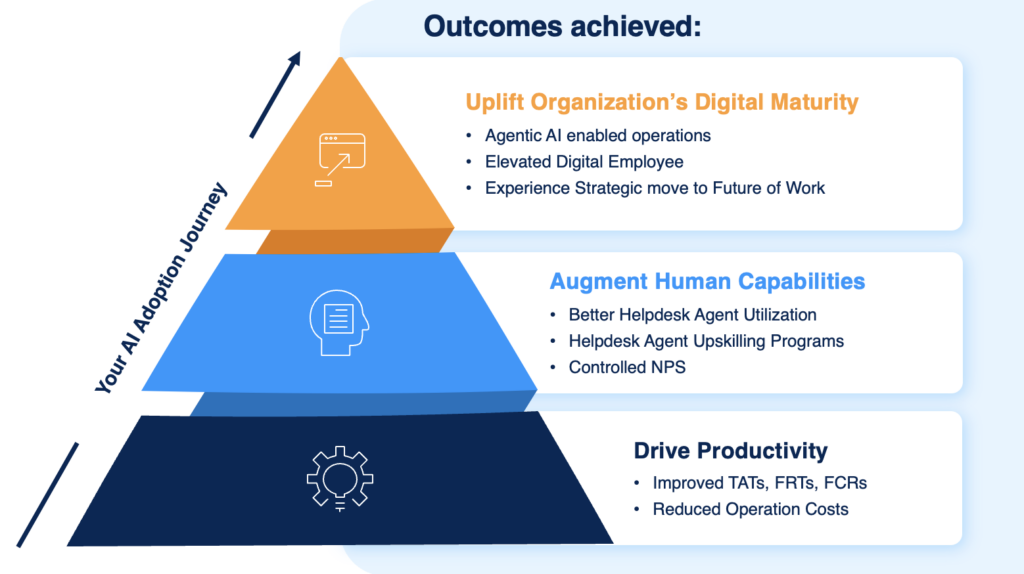
Begin your AI service desk initiative by targeting productivity improvements as the first milestone. Enhancing ticket resolution and operational efficiency should be the immediate focus. As your organization’s maturity grows, shift attention to empowering human agents through advanced service desk triage and agentic AI technologies.
Ultimately, the goal is to evolve the service desk into a unified support hub that addresses the needs of multiple business functions, thereby elevating the organization’s overall digital maturity. It’s important to recognize that true progress in AI adoption is measured not just by the number of users leveraging AI, but by the breadth and impact of AI-powered use cases across the enterprise.
2. Prioritizing an adoption-focused implementation
To achieve meaningful cost savings, AI implementation must center on user adoption. Reducing tool sprawl and embracing a controlled rollout approach allows organizations to pilot AI solutions without incurring additional costs. During the stabilization period, both human agents and AI systems should collaborate and learn from each other, continuously enriching and expanding use cases. This approach lowers the direct cost per ticket and enables human agents to upskill, equipping them to manage a broader array of technologies and tools.

Learn more: How Agentic AI Frameworks Deliver Measurable Efficiency, Scale, and Resilience
Key considerations for effective AI deployment
Successful AI deployments also depend on seamless integration with existing systems, scalability, flexible pricing models, and comprehensive user training. The most effective solutions are those that meet employees where they are—within the tools and workflows they already use.
Pomeroy’s solution: SmartDesk powered by BanzAI
At Pomeroy, we help our clients achieve substantial operational and cost advantages through the strategic implementation of AI within the IT service desk. Our SmartDesk, powered by the BanzAI platform, is an advanced AI-driven service desk designed to automatically resolve enterprise service requests across IT, HR, Finance, Legal, Facilities, and Customer Service. By combining human-level intelligence with zero-touch automation, SmartDesk unifies support across the enterprise, creating a single, seamless point of contact for all employee needs.
What sets SmartDesk apart is its alignment with industry best practices for AI adoption. We guide organizations through an outcome-driven journey—starting with measurable productivity improvements and evolving toward a unified support hub that elevates digital maturity across business functions. Our approach prioritizes user adoption, controlled rollouts, and continuous collaboration between human agents and AI, ensuring that solutions are not only effective but also scalable and sustainable. BanzAI combines the best of generative AI and AI agents to form the backbone of a cohesive, next-generation service desk.
With a focus on seamless integration, scalability, flexible pricing, and comprehensive user training, SmartDesk meets employees where they are—within the tools and workflows they already use. The result is a unified service experience that empowers employees to get instant support on any issue, without the frustration of navigating multiple portals or teams. In essence, SmartDesk transforms the service desk into a strategic enabler of enterprise-wide efficiency and innovation.
Pomeroy can help your organization realize the full value of an AI-powered service desk. Request a demo today.